
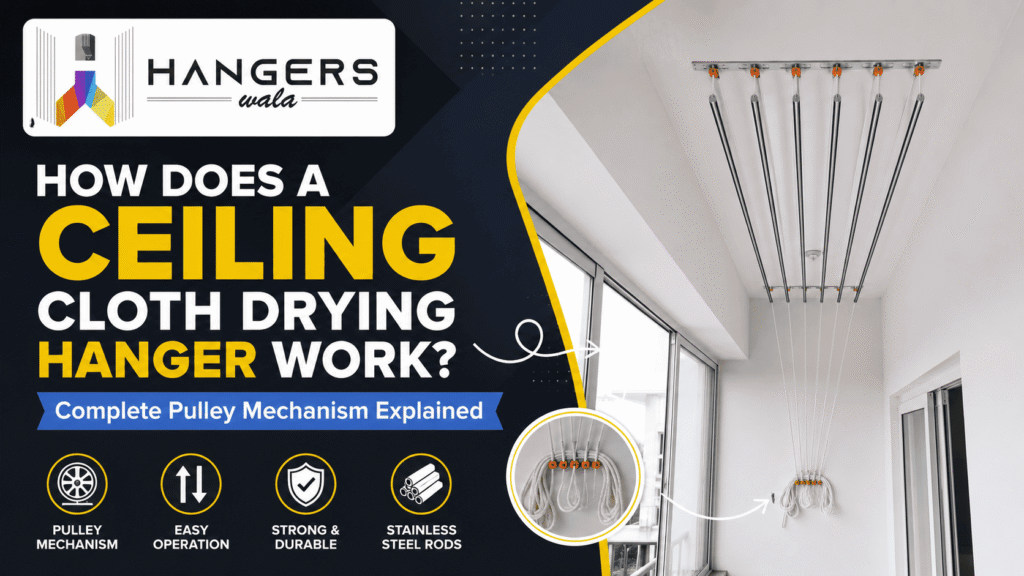
To understand how a ceiling cloth hanger works, you have to know about the pulley mechanism. A cloth drying hanger uses a pulley mechanism to allow the rods to go from the ceiling to a more convenient hanging position. The hanger is fixed to the ceiling, and the rods are vertically adjustable thanks to the pulleys and ropes.
The primary goal of this mechanism is to ensure that the user can lower the rods to hang clothes, and then raise the rods to the ceiling after the clothes have been hung.
How Does a Ceiling Cloth Drying Hanger Work?
A ceiling cloth drying hanger uses a pulley system to connect each drying rod to a hanging mechanism. Each of the rods is supported by a ceiling mounted structure through a pulley system.
To lower the rod, the user has to pull the rope down. The rod connected to the rope will also lower. To bring the rod back to its original position, the user has to pull the rope up in the opposite direction.
This system is convenient for utility spaces, balconies, and other spaces where hanging clothes can be a pain due to the ceiling height.
How Does the Pulley Mechanism Work?
The main workings of a ceiling cloth drying hanger are the pulleys. Each rod is connected to a rope and is able to move vertically thanks to the pulley system.
Here’s how it works.
- Join rod to rope.
- Rope goes through pulley.
- Pulley connects to support mounted on ceiling.
- Pull rope. Rise rod.
- Rod lowers to convenient height.
- Clothes can be placed on rod.
- Raise rod towards ceiling.
So no need to worry if the rope breaks, it’s not the only thing holding up the rod; the pulley converts pulling motion to vertical motion of the drying rod.
How does the rope lift and lower the rod?
The rope is the only thing that moves the drying rod.
Pulley and drying rod system works as the rope is pulled in a certain direction, rod either goes up or down.
To control the strain applied on the rope which in return controls how much effort is needed to operate the system, pulleys should be installed which allows the rope to move easily.
The quality of the rope matters as well. A normal system might use a regular rope while a Deluxe Quality system might use a better braided rope.
How does
individual rod pulley system work?
Each rod is operated separately.
Compared to a system which brings all rods to operate together, this system operates a separate rod in a separate pulley and a rope arrangement.
As an example, to keep clothes on one rod only, operate only that one rod.
It is useful to have a system wherein multiple types of clothing can be hung simultaneously. It is practical to have the ability to place each rod at a desired location.
What Are the Main Components of the Mechanism?
A ceiling cloth drying hanger has various parts and functions.
1. The Drying Rods
Hangers Wala systems use Jindal stainless steel rods. These rods are designed to withstand regular use and are larger than the drying area.
The lengths of the drying rods can be selected based on the available space and include 5 ft, 6 ft, 7 ft and 8 ft options.
2. The Pulley
The pulley is one of the key components of the lifting mechanism and guides a rope to raise and lower the drying rods.
3. The Rope
The rope connects the drying rods to the pulley. To move the rods, pull the rope.
Depending on the selected quality, the system uses either a twisted rope or braided rope.
4. The Bracket
The bracket is the supporting structure to the pulley and other components and requires a strong bracket to securely fit the mechanism to the ceiling.
A metal bracket is used in deluxe quality systems and in other systems a fiber bracket or PVC components are used instead.
5. Ceiling Mounting Support
The mechanism is fixed to the ceiling with the support designed to take the load of the hanger and the drying clothing.
How Do You Use a Ceiling Cloth Drying Hanger?
Using this system is simple.
To start, position the Cloth Clips rods using the pulley and rope mechanism. Set the rods at a convenient position to hang clothes.
Using the system of pulleys and ropes, lift the rods to hover the clothes at the most convenient position to dry and save space on the floor or balcony.
Most users enjoy the convenience of not needing a step stool to hang clothes.
Why Does the Rod Move Up and Down?
There is a pulley and rope system that is vertically moving the rod.
The pulley is fixed on the ceiling support. The system of rope pulling is connected to the rod. When there is movement on the rope, the rod follows and changes its vertical position.
How Does the Mechanism Help With Drying Clothes?
The lifting mechanism moves the Cloth Clips to a convenient position to place them at, and then lifts them to a higher position after hanging.
When the rods are placed higher, the clothes can be moved to a position above the working or walking area. The open space between the rods allows air flow around the clothes.
Enough space between the clothes is necessary for the air to circulate and dry the clothes completely.
What Happens If the Rope Does Not Move Smoothly?
If the rope becomes stiff, the first step is to check the rope and pulley area.
There may be a problem with the smooth movement if the area is dusty, has dirt, or is not in the correct position. The rope also needs to be clean, and the pulley needs to be checked.
Regular maintenance does not mean checking it every single day. Keeping it clean and checked from time to time will help the mechanism to function smoothly.
If the rope or the pulley is not working, it is always better to get it checked, instead of putting too much force to make it work.
Why Is Proper Installation Important?
As the entire mechanism is mounted on the ceiling, the correct placement of the brackets, pulleys, and ropes is essential to ensure smooth functioning of the mechanism and rods.
The ceiling must also be able to support the mechanism.
In the case of incorrect installation, the balance of the rope and pulley system is broken, which results in a harder to operate hanging rod system.
Professional installation ensures that all components are placed correctly.
How Does a Ceiling Cloth Drying Hanger Save Space?
Rather than using floor space, this hanger uses the space on your ceiling.
When clothes are finished drying, the rods can be brought upward, freeing up floor space. Such a system can be used in utility areas, compact spaces, and even on balconies.
This system is possible thanks to the pulley.
Why a Pulley-Based Ceiling Cloth Hanger?
The main advantage of a ceiling cloth hanger is vertical movement and space control.
This allows you to :
- lower the rods before loading
- raise the rods after loading
- use each rod individually
- change the way your ceiling is used
- keep higher areas out of reach
- Free up floor space
This system is a simple solution to the issue of using vertical space in homes with limited drying space.
Final Answer: How Exactly Does It Work?
A ceiling cloth drying hanger is a combination of rods, ropes, pulleys and support systems that are mounted to the ceiling.
A pulley system is mounted to a ceiling support. A rope connects the pulley to the drying rod. By pulling the rope, the pulley system is used to changed the height of the rod.
The system is very simple, but solves a very common problem. Each rod has independent control due to the pulley system.
The principle is simple:
Pulling the rope in a particular direction makes the movement of the pulley easy, allowing the rod to come into play, helping you hang the clothes, moving the rod up makes the cloth dry above the rod.
This is how the ceiling cloth drying hanger system works.
Conclusion
The ease of using the ceiling cloth drying hanger system is attributed to its mechanical simplicity. The main components of this system are the drying rods, the pulley, the rope, the bracket, and of course the ceiling mounting support.
The pulley system allows the rods to be moved in the vertical direction, and each of the vertical rod systems allows individual control of the rods. With good installation and sometimes needed maintenance, the system will work smoothly everyday.
Hangers Wala has designed different ceiling cloth drying hanger systems with varying degrees of quality, sizes of rods and configurations of the components to meet the requirements of different homes.